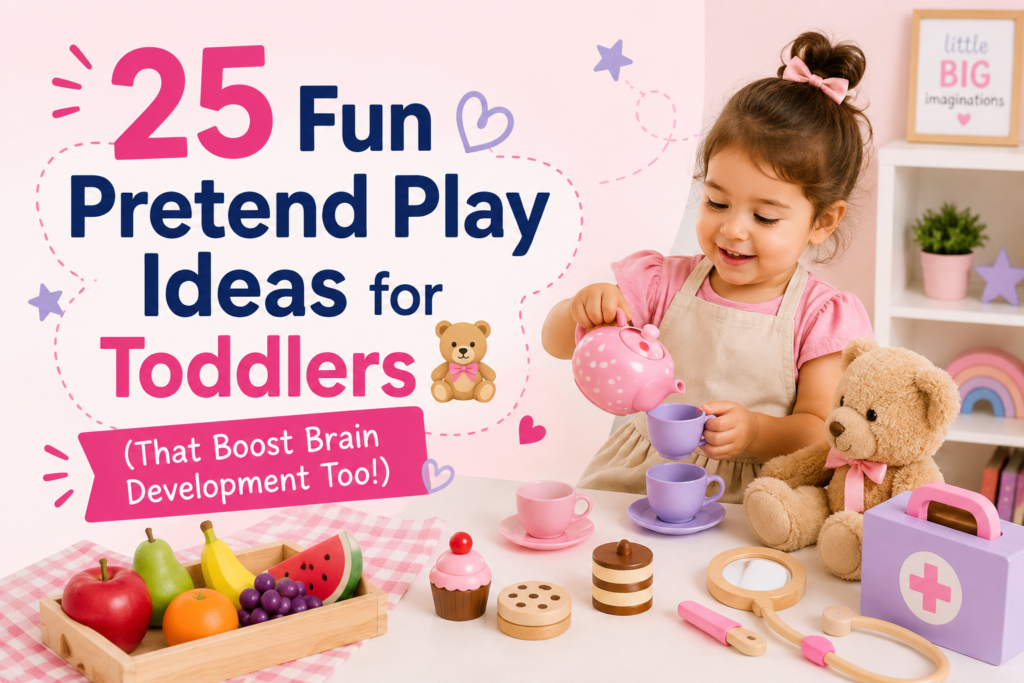
25 Fun Pretend Play Ideas for Toddlers (That Boost Brain Development Too)
Your toddler hands you an empty cup and says “Drink tea, Mama!” — and just like that, their brain leveled up.
That tiny moment of pretend play? It’s quietly building your child’s language skills, empathy, creativity, and problem-solving ability — all at once. The American Academy of Pediatrics recognizes free play as one of the most important tools for healthy brain development in early childhood.
The best part? You don’t need a playroom full of fancy toys. A cardboard box, some stuffed animals, and ten minutes of your time can work wonders.
Below you’ll find 25 easy, fun pretend play ideas organized into five themed groups. Most use things you already have at home. For each one, I’ve noted which developmental skill it builds — so you know exactly what’s happening inside that little brain while they’re having a blast.
🧠 What Pretend Play Actually Does for Your Toddler’s Brain
- Builds vocabulary & communication skills
- Teaches empathy & emotional regulation
- Develops problem-solving & critical thinking
- Boosts creativity & confidence
- Improves social skills like sharing & turn-taking
- Strengthens the parent-child bond
Hand your toddler a notepad and crayon. They’re the waiter — let them take your order, “cook” in their play kitchen, and serve it on a plate. Bonus points if they make a menu! This builds language skills as they learn to communicate orders, say “please” and “thank you,” and narrate what they’re cooking.
Language & CommunicationSet out playdough (or real dough if you’re feeling brave!) with cookie cutters, a rolling pin, and a baking sheet. Your little baker shapes cookies, decorates them, and “bakes” in a pretend oven. They practice fine motor control while learning sequencing — mix, roll, cut, bake, serve.
Creativity & Fine MotorLine up play food (or real pantry items) on a low shelf. Give your toddler a bag or basket and a “shopping list” with pictures. They pick items, bring them to the “checkout counter,” and pay with play money. This is math, sorting, and decision-making wrapped in pure fun.
Math & SortingThe Melissa & Doug Food Groups Set (21 Pieces) is perfect for the restaurant, grocery store, and kitchen ideas. Wooden play food sorted into five food groups — it teaches nutrition while they play. Thousands of 5-star reviews from moms.
Gather stuffed animals around a blanket. Set out cups, a teapot (or any pitcher), and “snacks.” Your toddler pours pretend tea, passes napkins, and practices manners — “Would you like more, Mr. Bear?” It’s social skills training disguised as the cutest afternoon ever.
Social Skills & MannersUse playdough balls or rolled-up socks as “scoops.” Your toddler takes flavor orders, stacks scoops on a cone (cup works too), and adds pretend toppings. They practice memory (remembering orders), counting (how many scoops?), and creativity (inventing new flavors).
Memory & CountingWant to level up ice cream play? The Melissa & Doug Scoop & Serve Ice Cream Counter comes with 28 pieces — scooper, cones, cups, and toppings. It’s a birthday gift goldmine. Also try the Slice & Bake Cookie Set for Idea #2 — kids go wild for the toppings.
Give your toddler a child-sized broom, a spray bottle filled with water, and a cloth. Let them “clean” alongside you. They’ll sweep, wipe, and spray with total seriousness. It builds gross motor skills, teaches responsibility, and — honestly — sometimes they actually help.
Motor Skills & ResponsibilityThe Melissa & Doug Dust, Sweep & Mop Set is the #1 most-bought toddler cleaning toy on Amazon. Child-sized broom, mop, duster, and a storage stand — moms swear by this one.
Dump a pile of clean clothes (socks work great) on the floor. Ask your toddler to sort by color, match sock pairs, or “fold” towels. It’s a sneaky lesson in sorting, pattern recognition, and following instructions — and they feel so proud helping with “grown-up work.”
Sorting & PatternsGrab a toy hammer, wrench, or even a wooden spoon. Point to something that “needs fixing” — a wobbly chair leg, a door hinge, a broken toy. Your little handyperson gets to work, tapping and turning. This encourages problem-solving and builds confidence through hands-on work.
Problem SolvingUse plastic cups as pots, spoons as shovels, and craft paper as flowers. Your toddler digs, plants, and waters their “garden.” If you have outdoor space, even better — let them actually dig in dirt and water real plants. It sparks curiosity about nature and science.
Science & CuriosityA stuffed animal becomes their “pet.” They feed it (with a bowl and pretend food), brush its fur, take it for a walk on a string leash, and put it to bed. This one is pure empathy and nurturing skills in action — they’re learning to care for something beyond themselves.
Empathy & NurturingYour toddler checks your heartbeat (hand on chest), gives you a pretend shot, and wraps a bandage around teddy’s “boo-boo.” This is one of the most powerful pretend play scenarios for building empathy — children learn to recognize pain, offer comfort, and practice caregiving.
Empathy & CaregivingLine up stuffed animals as “patients.” Your toddler examines them, listens to their tummy, gives them pretend medicine, and sends them home with a clean bill of health. Same empathy benefits as doctor play, but animals make it even more engaging for animal-loving kids.
Empathy & VocabularyThe Meland Toy Doctor Kit comes with a plush dog patient, stethoscope, carrying bag, and a dress-up doctor coat. Keeps kids busy for hours — perfect for Ideas #11 and #12.
Crumple orange and red paper as “fire,” place it somewhere in the room, and let your toddler spray it with a water bottle to “put it out.” They rescue stuffed animals from the scene. This builds bravery, quick thinking, and an understanding of community helpers.
Bravery & Quick ThinkingYour toddler lines up their toys in a row — those are the “students.” They read a book to the class, point at letters on a paper, and give everyone a gold star (sticker). This reversal of roles builds leadership, confidence, and early literacy skills as they mimic what they see in school or storytime.
Leadership & LiteracyHelp your toddler “write” letters (scribbles count!), put them in envelopes, and deliver them to different rooms in the house. A shoebox becomes the mailbox. They practice early writing skills, learn about communication, and get a sense of purpose with every delivery.
Writing & PurposeDrape a blanket over chairs — that’s the tent. Add a flashlight, a pretend campfire (red/orange paper), and some snacks. Tell campfire stories, roast pretend marshmallows, and look at “stars” (glow-in-the-dark stickers on the ceiling). This builds imagination and storytelling skills.
Imagination & StorytellingHide a few small toys or crackers around the room. Draw a simple “treasure map” with X marks. Your toddler follows the clues, finds the treasure, and celebrates. This is problem-solving, spatial awareness, and pure adventure — all before lunch.
Problem SolvingA large cardboard box becomes a rocket ship. Cut a window, add some buttons (drawn with markers), and countdown from 10. Your toddler “blasts off” to the moon, looks out the window at pretend planets, and reports back to Mission Control (that’s you). Creativity overload.
Creativity & CountingScatter stuffed animals around the room — they’re wild animals in the “jungle.” Your toddler uses toilet paper roll binoculars to spot them, names each animal, and learns fun facts. Great for building vocabulary and learning about animals and habitats.
Vocabulary & DiscoverySpread a blue blanket on the floor — that’s the ocean. Lay out towels, sunglasses, a bucket, and some shells (or pasta shapes). Your toddler splashes in the “waves,” builds a sandcastle (blocks work!), and applies pretend sunscreen. Sensory play meets imagination.
Sensory Play & ImaginationYour toddler picks a few toys to “sell.” They put price stickers on each one (sticker dots work great), arrange them on a shelf, and use a play cash register to ring up customers. This introduces numbers, money concepts, and the basics of exchange — buy, sell, give change.
Math & Money ConceptsThe Learning Resources Pretend & Play Calculator Cash Register has a real working calculator, play money, and a pretend credit card. It makes every shop-themed idea 10x more engaging — perfect for Ideas #21 and #24.
Your toddler brushes your hair (or a doll’s), uses pretend scissors (two fingers snipping), and styles it with clips or headbands. Add a “mirror” (a shiny tray) and a cape (towel around shoulders). They practice fine motor skills and creative self-expression.
Fine Motor & CreativityFill a small tub with soapy water. Your toddler drives toy cars through the “car wash,” scrubs them with a sponge or toothbrush, rinses, and dries them with a cloth. It’s sensory play meets pretend play — and it’s the kind of messy-but-contained activity toddlers live for.
Sensory & Motor SkillsSet up a small table with cups, a pitcher of water (or pretend), and play money. Your toddler takes orders, pours “lemonade,” collects payment, and makes change. This is a social skills powerhouse — they practice conversation, counting money, and serving with a smile.
Social Skills & MathUse stickers as stamps, fold paper into envelopes, and write addresses (scribbles are fine!). Your toddler delivers “mail” to every room in the house — one for the kitchen, one for the bedroom, one for daddy. This encourages early writing, sorting, and a wonderful sense of responsibility.
Writing & Responsibility📋 Want a Printable Version of This List?
Download the free 25 Pretend Play Ideas Checklist — print it, stick it on your fridge, and never run out of play ideas again. Check off each idea as you try it!
Download Free Checklist →Keep the Pretend Play Going All Year
Now that your toddler is in pretend-play mode, keep the magic going with our Seasonal Pretend Play Printable Bundles. Each bundle comes with themed activity sheets, coloring pages, and play prompts — designed to match what your child is already excited about.
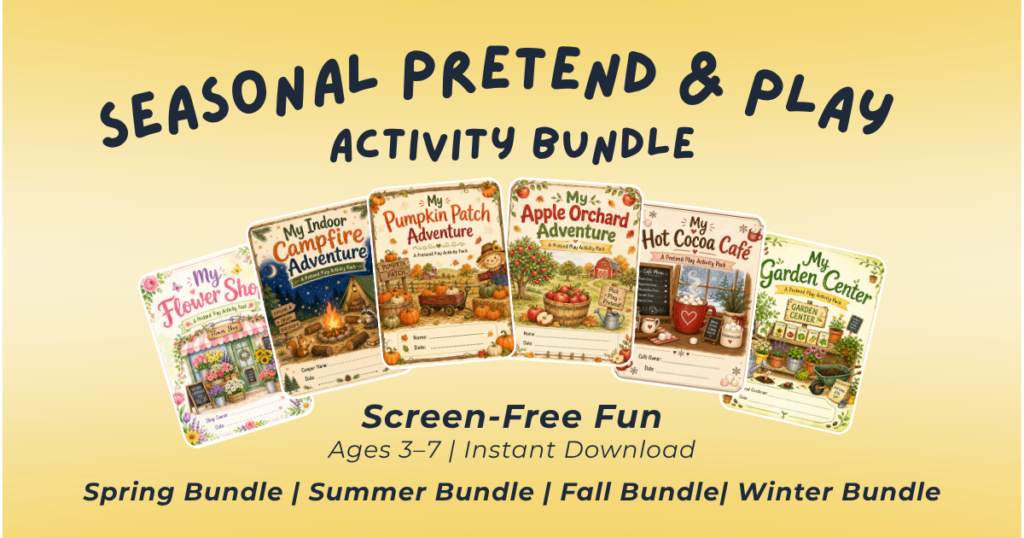
Flower Shop + Garden Center — plant, arrange, and sell pretend flowers!
Lemonade Stand + Beach Day — pour, sell, splash, and play!
Apple Orchard + Pumpkin Patch — pick, sort, and count the harvest!
Hot Cocoa Café + Indoor Campfire — cozy up and play all winter long!
Visit Our Full Store on Payhip →
Frequently Asked Questions
Most toddlers begin simple pretend play around 18 months — like pretending to drink from an empty cup or feeding a stuffed animal. By age 2–3, their pretend play becomes more complex, with storylines, multiple characters, and role-playing scenarios.
Not at all! Most of the ideas in this list use everyday household items — cardboard boxes, blankets, spoons, stuffed animals, and paper. Purpose-built toys like play food sets and doctor kits can enhance the experience, but they’re optional, not required.
Pretend play strengthens neural connections related to language, empathy, problem-solving, emotional regulation, and creativity. When a toddler “cooks” a meal or “treats” a stuffed animal patient, they’re practicing real-world skills in a safe, low-pressure environment. Research consistently shows that children who engage in regular pretend play develop stronger social and cognitive skills.
There’s no fixed time. For toddlers aged 1–2, even 5–10 minutes of focused pretend play is great. By age 3–4, many kids will happily play for 20–30 minutes or longer, especially if they’re engaged in a favorite scenario. Follow your child’s lead — when they’re done, they’re done.
Your Turn, Mama!
You don’t need expensive toys or a Pinterest-perfect setup. A cardboard box, some stuffed animals, and 10 minutes of your time — that’s all it takes to give your toddler a brain-boosting, giggly, magical play session.
Pick one idea from this list and try it today. Tomorrow, try another. Before you know it, you’ll have a toddler who can run a restaurant, treat a teddy bear’s broken leg, and deliver mail to every room in the house — all before naptime.